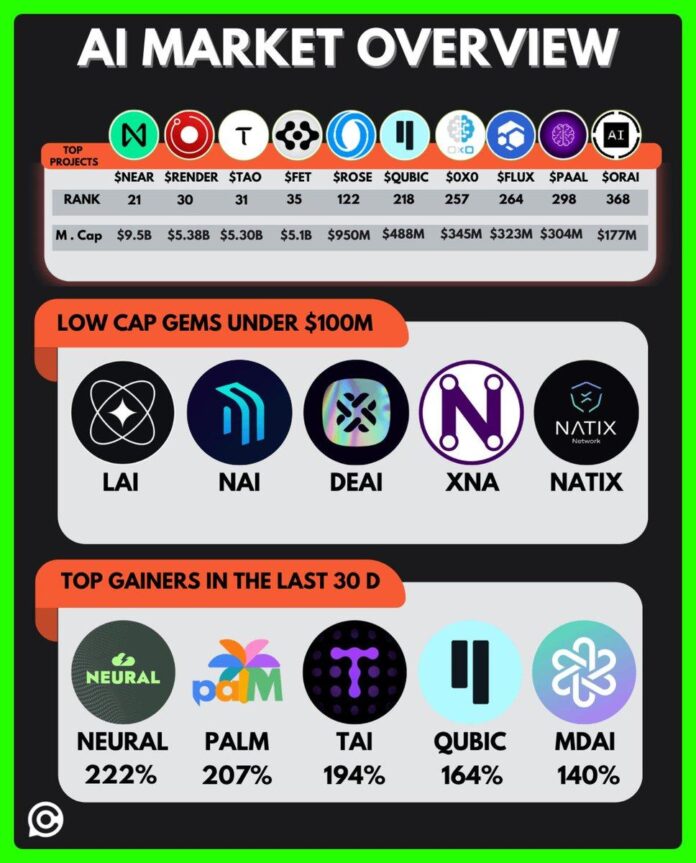

Artificial intelligence isn’t only reshaping Big Tech; it’s rewriting the crypto leaderboard. From smart-contract platforms that turbo-charge machine learning to specialized tokens that rent GPU cycles on-chain, AI altcoins are grabbing headlines and venture capital. In the past quarter the sector’s total market cap has soared, with names like $NEAR, $RENDER and $FET leading the charge, while a fresh crop of micro-caps hustles for attention. Whether you’re an early adopter or a cautious investor, knowing which protocols bring real utility—and which are pure hype—can help you ride the next wave instead of being crushed by it.
AI Heavyweights: $NEAR, $RENDER & The Big League
With mature ecosystems and deep developer benches, $NEAR and $RENDER act as bellwethers for the entire AI-crypto niche. $NEAR provides high-speed sharded smart contracts that can run complex machine-learning models on-chain, making it a popular base layer for decentralized AI dApps. $RENDER, by contrast, tokenizes 3D rendering and AI inference tasks, letting creators rent unused GPU horsepower from a global network of node operators. Both projects are backed by reputable teams, marquee investors, and meaningful revenue. They’re not cheap, but they already solve real problems, exactly why institutions treat them as the “safe” AI plays of the current cycle.
Compute & Hardware Focused: $TAO, $FET, $FLUX

Compute-intensive AI requires dedicated infrastructure, and that’s where $TAO (Bittensor), $FET (Fetch.ai) and $FLUX step in. $TAO incentivizes a peer-to-peer neural-network marketplace, rewarding miners who contribute model training and inference power. $FET blends autonomous agents with a data marketplace; think of it as a decentralized Amazon Web Services for bots. $FLUX focuses on decentralized cloud computing, giving AI developers on-demand CPU and GPU resources without centralized gatekeepers. Together, these three tokens form the backbone of “AI as a service” on the blockchain, and they’re positioned to capture soaring demand for compute as models grow ever larger.
Privacy & Security Leaders: $ROSE, $ORAI

Training models is pointless if the data isn’t secure. $ROSE, the token behind Oasis Network, uses confidential computing and zk-proofs to keep sensitive datasets private while still allowing analytics and machine learning. $ORAI (Oraichain) layers verified AI APIs on top of Cosmos, delivering trusted outputs to smart contracts and bridging off-chain data in a tamper-proof way. Both projects target sectors, healthcare, finance, government, where privacy is non-negotiable. As regulators tighten rules around data sovereignty, privacy-first chains could leapfrog better-known rivals. Keep an eye on enterprise pilots; a single high-profile deployment could send these tokens into price-discovery mode.
Frontier Tech Bets: $QUBIC & $OXO

Most blockchains mimic yesterday’s cloud, but $QUBIC and $OXO are gunning for tomorrow. $QUBIC proposes a qubic computing architecture that could one day mesh quantum-style parallelism with decentralized consensus, theoretically handling AI workloads that dwarf today’s models. $OXO, for its part, experiments with optical and neuromorphic hardware integrations, hoping to slash energy costs. Both tokens trade thinly and carry outsized risk, yet they illustrate the moon-shot mentality that built crypto in the first place. If either team even partially delivers, early holders could be sitting on the AI domain’s equivalent of an early Ethereum or Solana.
The Chatbot Darling: $PAAL
For retail investors craving a clear use case they can actually try, $PAAL is becoming the poster child. The project offers AI chatbots that can be customized, monetized, and embedded into social platforms within minutes. Every time a bot answers questions, translates text, or manages a Discord community, token demand is generated through fees and staking. The model is simple, tangible, and fast-moving, qualities that resonate in a market often flooded with jargon. While critics question long-term defensibility, $PAAL’s brisk adoption curve shows that sometimes the most straightforward utility can outperform grander, more academic visions.
Low-Cap Gems to Scout: $LAI, $NAI, $DEAI, $XNA, $NATIX

Finding the next 50-timer means digging into low-cap gems, and the current watchlist looks like this: $LAI (LayerAI) aims to democratize edge-device inference; $NAI (NexaAI) bundles AI analytics into DeFi dashboards; $DEAI focuses on decentralized data labeling; $XNA (Neurai) brings TinyML to IoT sensors; and $NATIX tokenizes crowdsourced street-level imagery for smarter cities. Combined market caps barely cross eight figures, so slippage is real, but these micro-caps give retail a crack at asymmetrical upside. As always, position sizing is crucial, assume half will fade, a couple will break even, and maybe one will change your life.
30-Day Moonshots: $NEURAL, $PALM, $TAI, $QUBIC, $MDAI

A quick glance at the 30-day leaderboard shows what hype plus momentum can do: $NEURAL surged 222 %, $PALM 207 %, $TAI 194 %, $QUBIC 164 %, and $MDAI 140 %. The common denominator? Catalysts. $NEURAL launched a new on-chain inference marketplace; $PALM secured an enterprise NFT deal; $TAI revealed a transformer upgrade; $QUBIC teased a testnet; $MDAI announced a Binance Labs grant. Traders who spotted the news early banked triple-digit returns. The lesson is clear, AI tokens move on milestones. Setting alerts for GitHub commits, partnership announcements, and roadmap deadlines can be more valuable than hours of chart gazing.
Key Metrics to Gauge AI Altcoins

Before apeing in, get acquainted with the metrics that separate serious AI protocols from vapor. Check active GPU nodes, inference jobs processed, and revenue-per-token, not just Telegram headcount. Scrutinize tokenomics: Is supply inflation capped? Are rewards tied to real compute or artificial emissions? Review the code, does it rely on off-chain APIs that can be rug-pulled? Finally, assess the moat: proprietary data, patented hardware links, or network effects? Combining on-chain analytics with Web2 indicators like GitHub stars and LinkedIn hiring trends will give you a 360-degree view of project health and staying power.
Who Could Dominate the Next Cycle?

Asked which AI altcoin has the biggest potential, analysts split into two camps. Pragmatists pick $NEAR or $RENDER, betting on proven adoption. Visionaries aim at $TAO or $QUBIC, hoping for disruptive leaps in decentralized compute. A contrarian might eye $LAI or $NATIX, arguing that smaller treasuries foster innovation faster. The truth is, leadership will likely rotate as use cases evolve, data ownership today, on-device AI tomorrow, quantum beyond that. Diversification across market-cap tiers and sub-sectors can capture whichever narrative catches fire, turning the impossible prediction into a probabilistic edge.
Smart Ways to Get Exposure Without Losing Sleep

Volatility is the toll you pay for outsized upside, but you don’t have to mortgage your sanity. Allocate a core 5–10 % of your crypto stack to established AI majors, layer in 1–2 % for speculative micro-caps, and keep equal value in stablecoins to buy dips. Use automatic DCA, stake tokens where possible to offset dilution, and set clear invalidation points instead of emotional stop-losses. Above all, stay engaged: contribute data, run a node, or test beta products. Active community members often receive airdrops, free optionality that turns patient participation into compound returns.