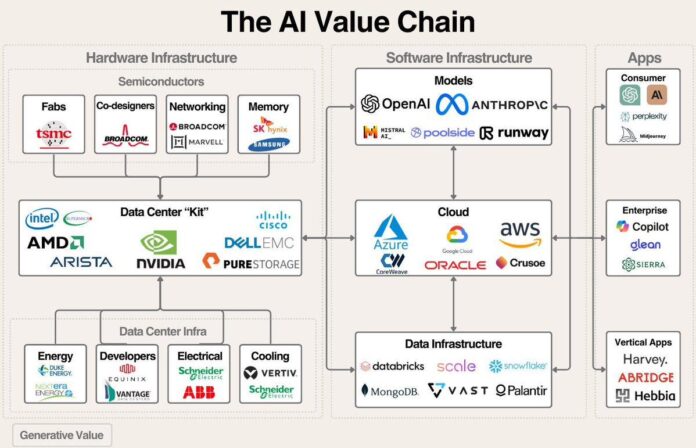

Artificial intelligence is more than chatbots and deepfakes; it’s a sprawling supply chain that stretches from sand turned into silicon to the app icons on your phone. Understanding who makes money at each stop along that journey can give investors an edge. Below, we break the “entire AI value chain” into seven core layers—semiconductors, data centers, infrastructure, cloud, data platforms, models and applications—and spotlight the public companies (plus a few private giants) dominating each. Spoiler: the flashiest products aren’t always the best investments. Sometimes the boring picks and shovels mint the real fortunes.
Semiconductors: The Silicon Heart of AI
Semiconductors are AI’s bedrock. Without advanced chips, no algorithm, however brilliant, can run fast enough to matter. Taiwan Semiconductor Manufacturing Co. (TSMC) remains the undisputed foundry king, printing silicon for Apple, Nvidia and a who’s-who of startups. On the design side, Nvidia’s H100 and upcoming Blackwell GPUs set the training pace, while AMD’s MI300X hopes to undercut them on price-performance. Intel is regrouping with Gaudi and Foundry 2.0, Marvell and Broadcom dominate networking ASICs, and SK Hynix plus Samsung feed the insatiable appetite for high-bandwidth memory. Together, this group sells the literal picks and shovels of the AI gold rush.
Data Centers: Industrial Muscle for Machine Learning

Data centers, they’re the steel mills of the digital age. Every ChatGPT query is routed through a warehouse-sized cluster of servers, switches and storage built by quiet specialists. Dell Technologies still commands the x86 server market, while Super Micro Computer tailors GPU-dense racks that can gulp 100 kW apiece. Cisco and Arista Networks move the petabits between nodes, and Pure Storage pumps data from all-flash arrays without bottlenecks. To handle the next wave, operators are experimenting with liquid cooling, optical interconnects and modular bays that can be swapped like LEGO bricks. If semis are brains, these facilities are the body.
Infrastructure: Power, Cooling & Everything In Between

Infrastructure isn’t sexy, yet every watt that powers AI must be generated, conditioned and delivered. Utilities Duke Energy and NextEra are racing to site renewable-heavy grids near hyperscale campuses, while Equinix offers colocation space in 70+ metros. ABB and Vertiv supply the transformers, UPS systems and industrial chillers that keep racks humming, and Schneider Electric monitors it all with digital twins that predict failures before they happen. Building a single 100 MW data-center park can top $1 billion, but these companies earn stable, regulated returns that grow each time Nvidia launches a hotter chip.
Cloud Platforms: Renting Intelligence by the Minute

Cloud platforms are the operating system for modern AI work. Microsoft Azure, Amazon Web Services and Google Cloud battle to rent the latest GPUs by the minute, while Oracle’s Gen2 Cloud undercuts on price and bandwidth. Enterprises that once hesitated to move workloads off-prem now spin up thousands of A100 or MI300 instances with a few API calls. These providers add proprietary accelerators, AWS Trainium, Google TPU, to lock customers in, and they bundle managed services for vector databases, MLOps and end-point security. Whoever owns the hyperscale cloud ends up skimming value from every layer above it.
Data Platforms: Turning Raw Bits into Gold

No model can out-think the quality of the data it learns from. Snowflake and MongoDB make curated lakes and document stores easy to query at scale. Palantir’s Gotham and Foundry turn messy enterprise logs into structured knowledge graphs, while private unicorns Databricks and Scale AI prepare, label and stream terabytes into training pipelines. Governance matters as much as gigabytes: lineage, compliance and privacy rules are now embedded in the warehouse itself. Investors often overlook these backstage players, yet subscription revenue is sticky and switching costs high, exactly the traits that make Warren Buffett smile.
Foundation Models: The Brains Behind the Boom

Models are the celebrities of the stack. OpenAI’s GPT-4o, Meta’s Llama 3 and Anthropic’s Claude 3 headline press releases, while European upstart Mistral courts regulators with sovereignty talk. Though open-weights are trending, the cost to train a state-of-the-art large language model still nears $100 million in compute alone, creating a high barrier to entry. Expect specialization: smaller, domain-tuned models for medicine, finance and robotics running on fewer parameters but richer context windows. Ownership of proprietary training data, not just weights, will decide which labs build a durable moat.
Applications: Where the Magic Meets the User

End users don’t care about tensor cores; they care about results. Microsoft’s Copilot is quietly weaving AI into Office, turning Outlook drafts and Excel macros into natural-language tasks. Perplexity rewrites search with conversational answers, Midjourney replaces stock photography with stunning generative art, and a long tail of startups targets every vertical from contract review to music mixing. Most apps rely on open-source or leased models, so distribution and brand become decisive. The risk? Feature creep from the giants who own the platform. The upside? A direct line to the customer and data flywheel.
Investing Playbook: Picks, Shovels & Smart Bets

So where should an investor place their bet? History shows gold miners rarely get rich, hardware suppliers and tool merchants often do. In today’s rush, chip fabs, power utilities, networking gear and cloud landlords may compound profits more predictably than headline-grabbing chatbots. A barbell approach pairs steady picks like TSMC, Equinix and Duke with a focused basket of high-beta plays such as Nvidia or Microsoft. Spread risk across the stack, reinvest dividends, and resist chasing parabolic charts. Technology cycles are shorter than most holding periods; disciplined rebalancing beats bravado every time.