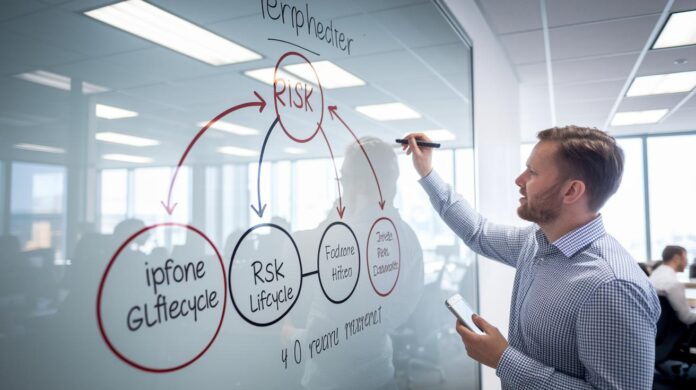

Ever notice how one missed risk can throw off an entire project? The risk management process acts like a simple recipe with five clear steps that guides you through each challenge.
It helps you spot problems early, gauge how big they might get, and fix them before they cause trouble. Picture it like carefully mixing ingredients so your project runs as smoothly as a well-cooked meal. This smart approach saves time and builds a stronger team, showing that handling risks wisely is key to success.
Comprehensive Lifecycle Overview: How the Risk Management Lifecycle Drives Structured Resilience
The Risk Management Lifecycle is like a simple recipe with five key steps. First, you look for any potential risks from both inside and outside the business, whether they touch on operations, strategy, money matters, or safety. Next, you figure out just how big each risk might be and which parts of the company could feel its impact.
Then comes ranking these risks, deciding which ones need a quick fix and which can wait for a regular check-up. After that, you set up plans to handle or lessen the risks – whether that means avoiding them entirely or putting safety controls in place. Finally, you keep a constant watch to catch any changes fast. This cycle forms a solid framework that helps the whole team stay on top of risks.
Keeping an eye on risks all the time is essential since challenges are never static. Business environments change quickly, and risks can multiply or shift without warning. By continuously monitoring everything, your team can spot new issues early and adjust right away to keep projects on track. Instead of relying on old-school methods like separate spreadsheets or random reports, a constant approach means you catch those risk signals immediately, reducing downtime and missed chances.
When your approach to managing risks lines up with the overall company goals, it really boosts your organization’s strength. Modern digital tools give you real-time insights that help leaders tie updates on risks directly to big decisions. This smooth connection minimizes surprises and creates a steady flow of clear, useful information. With advanced digital tracking and a proactive mindset, managing risks stops feeling like a routine task – it becomes a strategic tool that drives project success and supports broader business goals.
Stage 1: Identifying Threats in the Risk Management Lifecycle

In this first step, organizations look for things that might stop them from reaching their goals. This could be problems within the team or issues coming from outside. Think of it like checking your car for any loose parts before a long drive.
Teams might use tools like risk registers and logs, run SWOT or PESTLE workshops (tools that help you see strengths, weaknesses, opportunities, and threats), chat with important people in the project, hold scenario workshops, or simply keep an eye on what’s happening in the industry and environment.
Getting these threats on the table early gives a clear path for the next steps. With a solid view of what might go wrong, teams can use simple, strong risk assessment methods to fix small issues before they become big problems.
Stage 2: Analyzing and Measuring Risk Impact
In this phase, teams take a close look at each risk using two main approaches: one based on feelings and expert judgment, and another using hard numbers. The feeling-based approach uses simple scoring, much like giving a movie a rating from poor to excellent. This helps teams quickly see which risks feel more worrisome based on experience.
Then there’s the number-based method. Here, teams work with actual figures like interest rates and loss estimates, using statistical models that paint a clear picture of potential impact. Think of it as checking your car’s fuel efficiency before a long trip, it gives you confidence in the data.
Mixing these two methods creates a balanced view. With both clear numbers and informed ratings, teams can rank risks by how likely they are to occur and the impact they might have. This ranking shows which risks need immediate action and which can be managed over time. The insights feed into simple risk matrices and trigger thresholds that help decide where to focus resources. Ultimately, solid analysis sets the stage for smart, clear decisions that align with the organization’s overall strategy.
Stage 3: Evaluating and Prioritizing Risks for Strategic Action

Evaluating risks is really about figuring out which issues are most likely to occur and how much damage they might cause. It’s like sorting your daily tasks, some items need immediate attention, while others can be handled during your routine check-ups. Think of it as a financial manager ticking off errands on a to-do list.
A risk matrix is a handy visual tool that pairs the chance of a risk happening with how big its impact could be. This chart neatly divides risks into clear zones, making it simple to see which ones need urgent care. Picture a grid where the top right area signals a clear call to act fast.
Setting clear action levels means tagging specific points on this matrix that automatically prompt a strategic review. When a risk reaches one of these set points, the team jumps into action without hesitation. Just like a car’s fuel gauge that tells you when it’s time to refuel, these markers serve as a friendly reminder to take decisive steps.
Stage 4: Mitigation Planning and Control Implementation
Mitigation is all about handling risks by choosing the right actions, setting clear roles, and pinning down budgets and timelines. Here, teams work side-by-side with experts to put together a practical plan with clear communication methods and record-keeping templates. This way, instead of scattered emails and endless spreadsheets, everyone knows the steps to take.
There are four main strategies to manage risk:
- Avoidance – get rid of the risk completely.
- Transfer – move the risk to someone else using contracts or insurance.
- Mitigation – lessen the chance or impact so that even if it happens, the hit is minimal.
- Acceptance – recognize the risk when you really can’t avoid it, and plan your budget for it.
A strong mitigation plan means different departments need to work together and carefully assign resources. The plan shows everyone how to document and track actions smoothly. Regular budget checks and record updates make sure every step goes as planned. This organized approach helps keep projects on track, even when surprises pop up.
Stage 5: Continuous Monitoring and Review in the Risk Management Lifecycle

Digital tools have really changed the way teams watch over risks. These tools offer automated dashboards, clear risk signals, and real-time alerts whenever things change. Think of integrated risk software as a digital watchdog that keeps an eye on everything, much like a car’s warning light that pops on when the tire is low. It sends updates straight to your dashboard so you don’t have to check manually, helping everyone see when something isn’t quite right.
Regular audits and scheduled reviews work hand in hand with these digital tools, adding another level of safety. Running periodic checks and detailed audits means that both the risks and the safety measures stay strong even when things change in the business. This cycle of updates and reviews lets teams quickly adjust strategies to tackle new challenges. It’s like having a well-tended garden that’s always blooming, you see every change right away, and nothing gets overlooked.
risk management lifecycle: Boosting Project Success
Industry standards like ISO 31000 and COBIT form a strong base for connecting risk management with overall business goals. Think of these guidelines as the blueprint for a safe, flexible workspace. They give companies a step-by-step plan to handle both expected challenges and unexpected surprises, making projects more successful and the business more resilient.
Today’s digital tools bring this plan to life. Risk management software does the heavy lifting by organizing compliance tasks and keeping detailed records, much like a smart dashboard that lights up when it’s time to check something. With real-time data and AI-powered insights, these tools cut down on tedious manual work and offer quick pointers to keep every part of a project on track.
Data analytics and regular training sessions keep the process fresh and effective. By studying past trends and testing different scenarios, teams can get ready for any situation. Regular reviews and learning opportunities ensure everyone is up to speed with the best practices and latest technology. This ongoing effort turns risk management into a dynamic, forward-thinking process that supports long-term growth.
Final Words
In the action, the article walked through the risk management lifecycle, outlining each step from spotting potential issues to continuous digital monitoring. Each phase builds a clear structure that supports smart money choices. The overview shows how proactive steps, aligned with strategic aims, can boost confidence in handling financial risks. This clear and steady process empowers you to turn complex challenges into manageable tasks, leaving room for a positive outlook and lasting success.
FAQ
What are the five stages of the risk management lifecycle?
The five stages refer to identifying risks, analyzing their impact, evaluating or prioritizing based on severity, treating or mitigating risks, and continuously monitoring control effectiveness. This structure supports careful and ongoing risk handling.
What are the key steps in a four-stage risk management cycle?
A four-stage cycle usually merges some steps, covering risk identification, risk analysis, risk mitigation, and ongoing monitoring. This approach still offers a clear process for managing risks efficiently.
How does the seven-step risk management process work?
A seven-step process expands the traditional model to include additional review and communication steps. It typically involves risk identification, analysis, assessment, prioritization, treatment, monitoring, and reporting to ensure full risk coverage.
What does step 5 in the risk management process involve?
Step 5 emphasizes continuous monitoring and review. It involves using digital tools to track risk changes and reassess control measures, ensuring that risk responses remain effective over time.
Where can I find a PDF or concrete example of the risk management lifecycle?
You can find PDFs and practical examples from trusted sources online, which illustrate structured risk management frameworks and offer detailed diagrams to help guide implementation in various organizations.
How do frameworks like NIST or companies like Citi apply the risk management lifecycle?
These frameworks and organizations align their risk steps with standardized guidelines. They integrate the lifecycle into their governance practices to ensure systematic risk assessment, treatment, and monitoring throughout their operations.